Sunday, 1 January 2012

Time for Reflection

Happy New Year! 

If you're anything like me then January 1st brings an opportunity to reflect on the past year and re-evaluate your priorities and goals and perhaps to set plans for the coming year. I've never been very good at keeping New Year's Resolutions, but I believe it is helpful to take a moment to reflect and to take stock at where you're at to make sure you're still on the path you want to be on and, just as importantly, that you're moving forward.

Have you read 'Holiness' by J.C. Ryle? It's an excellent book that, even though it was written over a century ago, still is very applicable to today. In fact it's often funny to read what he says about his culture and realise that not much has changed in all that time. Anyway, Bishop Ryle has much to say about growing in holiness, and here's a prayer we can use to reflect on how we're doing spiritually from year to year. I hope you find it useful...

Prayer for Growth

1) An increase in humility - that I would feel my own sinfulness and unworthiness more every year.
2) An increase in faith and love towards the Lord Jesus Christ - that I may find more in Christ to rest upon every year and rejoice more that I have such a Savious.
3) An increase in holiness of life and conversation - that I may get more dominion over sin, the world and the devil every year.
4) An increased spirituality of taste and mind - that I may take more interest in spiritual things every year.
5) An increase in charity - that I may be more full of love every year, love to Christians and to all people.
6) An increase in zeal and diligence in trying to do good to souls - that I may take a greater interest in the salvation of sinners every year.

Here's another helpful resource, from Ann Dunagan of Harvest Ministry, that helps us evaluate and plan strategically at the start of the new year.

Wishing you all a very joyful and fruitful 2012!

Thursday, 1 December 2011

Finding Balance in the Christmas Season

The Christmas season is upon us! It took me a bit by surprise, with the first Sunday of Advent starting in November, but tonight I sat down and did some planning and am hoping that it'll be a fun and meaningful time for all of us.

Lots of the blogs I follow have already written about resources and tips for the festive season. Sometimes when I read them I do get a bit discouraged by how much time, energy and creativity everyone else must have apart from me. Then I remembered a verse from my Abiding Fruit Bible study that I'm doing this week with the Maximise Your Mornings challenge:

" Each of you should test your own actions. Then you can take pride in yourself, without comparing yourself to somebody else, for each of you should carry your own load." Galatians 6 v 4,5

It's hard not to compare yourselves with others, but everyone's situation is different, and everyone's stress tolerance levels are different. Here are some things to think about:

Stage of life: Perhaps some of us have very small children still, and a lot of energy is sapped in changing nappies or potty training or feeding or just mopping up messes and soothing grazed knees.
Situation: If you're like me, then you live in a foreign country far away from family. Often that means that just living daily life is more challenging and time consuming. Meals have to be made from scratch, craft materials are hard to come by, Grandma is not around the corner to help with the kids while you go shopping.
Character: Some of us are more energetic and social than others. I know for myself that, although I'd love to entertain more regularly, having guests round more than once every two weeks makes me exhausted and throws me off my schedule.
Health: Perhaps some of us have some health issues that drain our energy and make us want to retreat and sleep more.

The verses from Galatians encouraged me to stop looking at (and envying) other homeschooling mothers and just work out a happy balance in my own life that I can cope with. When the children are older hopefully we can do more things, but right now I'm in a season of life where I have to protect my energy levels.

So what are we doing for the advent season this year?
1) Advent calendars - we can't buy these here, but some friends in Germany sent us one each for the children. They love opening the doors and counting down the days.
Candle Ornaments from Truth in the Tinsel
2) Christmas crafts - I bought the amazing ebook Truth in the Tinsel, and am hoping to work my way through most of these daily projects with the children. Here's our first one from today:
3) Advent candles - we have an advent wreath, and each Sunday we light the next candle and Dh reads a relevant passage from the Bible and we talk about some aspect of Christmas.
4) Carols and mulled wine - I'm sad that we can't buy mince pies or mincemeat here, but I did bring some mulled wine sachets back from England for our now annual Carols and mulled wine evening. Some time this month we'll invite several expat families round and enjoy fellowship together whilst singing Christmas carols at the piano and taking turns to read Christmas-related Bible passages.
5) Festive spirit - the children are looking forward to helping me decorate the house this weekend, and yesterday I put on a CD of Christmas children's music and we all danced around the room.

I hope you all have a fun and meaningful advent season in your homes this year :-)

Tuesday, 15 November 2011

Homeschooling Overseas Part 2

It’s high time to continue with my series of posts on homeschooling. In this post I’d like to talk about our journey to becoming a homeschooling family. In the last post I highlighted some of the options that might be available if you’re living overseas. For us we only have two options here: either sending the children to local school or homeschooling ourselves. I’m not saying that one is better than the other. There are some ex-pat families here who send their kids to local school, and some who homeschool. It’s a decision that each individual family has to make. I’m just describing how we decided that homeschooling would be best for our family.

Our journey started when we came across some friends in England who had decided to homeschool. Both were Christian families, and both had different reasons for chosing that path, but I was interested to know how they were thinking about going about it. They recommended reading “For the Children’s Sake” by Susan Schaeffer Macaulay, which is I think where the journey starts for many families homeschooling today! Both my husband and I read the book, and were really struck by the ideals represented there. Not only did we feel that homeschooling might be something positive and beneficial for our family, but we were also impressed by the educational methods of Charlotte Mason described in the book. As many of you probably know, Charlotte Mason was a British educator who lived about 100 years ago and developed a philosophy of education based on Biblical principles and her observations of children over her years of teaching and training new teachers.

I started reading more books and doing more research, mostly on the internet. The more I read and studied the more I felt that God was calling me to do this. The thought of homeschooling didn’t terrify me, like I know it does some people, partly because I am a teacher myself by profession….a maths teacher, to be precise, which seems to be the one subject that scares off potential homeschooling mothers the most! I had a bad experience in my former life as a teacher, which put me off teaching in mainstream schools and led to my change of career that eventually brought me here, but I had always loved the heart of teaching: imparting ideas and knowledge to children and the satisfaction that comes from seeing ‘light bulbs’ go off in their heads as they make connections and finally ‘get it’. Surely it couldn’t be too difficult teaching my own children! At least I would only have a class of 3 rather than 36 to manage!

We did investigate the local kindergarten. The main advantage of sending our children to local school would certainly have been the fact that they would become fluent in Russian much more easily and quickly. We liked the school very much. The teachers were ever so friendly. We expressed concern at the long day (in Russia children typically go to kindergarten from 8am to 4 or 5pm, having breakfast, lunch, afternoon nap and sometimes dinner there from as young as 2 years old) but they assured us that it would be fine if we wanted to take Sophie home at midday. They invited us to the ‘end of year performance’ which was an afternoon of dancing, singing and poetry recital by the children to wish the 6-7 year olds well as they went off to ‘proper’ school in September (Russian children start school at age 7). We were very impressed by the seriousness with which these small children undertook the dances, and at the bravery of even quite little ones taking the microphone and reciting a poem off by heart to a fairly large audience of parents and relatives. However, I remember my main thought being “Look at those outfits the little girls are wearing. We could never afford to deck Sophie and Charis out in one of those at the end of each year!”. Indeed, these little 6 and 7 year olds looked more ‘done up’ than I did on my wedding day! Their gowns must have cost a fortune, and it looked like they’d spent at least 2 hours in hair and makeup that morning.

I think it was the dresses that swung it for me, but there were other reasons too. In this culture there are a huge amount of hidden costs behind seeing your child through school education. Teachers get paid very little and so unfortunately it's quite normal to give 'extra monetary gifts' to ensure good marks.There’s also all the paperwork and red tape that would be involved, partly because we’re foreigners but also partly because that’s the system here, and I really hate that kind of thing. Finally, Sophie’s personality is such that we didn’t think she’d do well being thrust into that kind of environment at a young age.

And so, to cut a long story…well…not very short, we started planning on homeschooling. To be honest, the more we thought about it the more we thought that this is a route we may well have taken if we’d back in England. It just seemed to fit what God had in mind for our family.

In my next post I’ll talk about how to respond to local friends and neighbours when they ask why we choose to homeschool.

Qu: If you homeschool, what was it that led you to that decision? I'd love to hear your stories.

Abide in Him!

Wednesday, 9 November 2011

Outdoor Hour Challenge No. 11 - Tree Study

I'm actually writing this entry having come to the end of our year long tree study project. We chose trees as our family focus last year when we started doing these Outdoor Hour Challenge and followed eight trees, two in our garden and six in our town park. I think, however, that I was a bit more interested in doing the study than the girls were, but I'm hoping they'll be interested when I put all the photos together and they can see how the trees have changed in the photos.

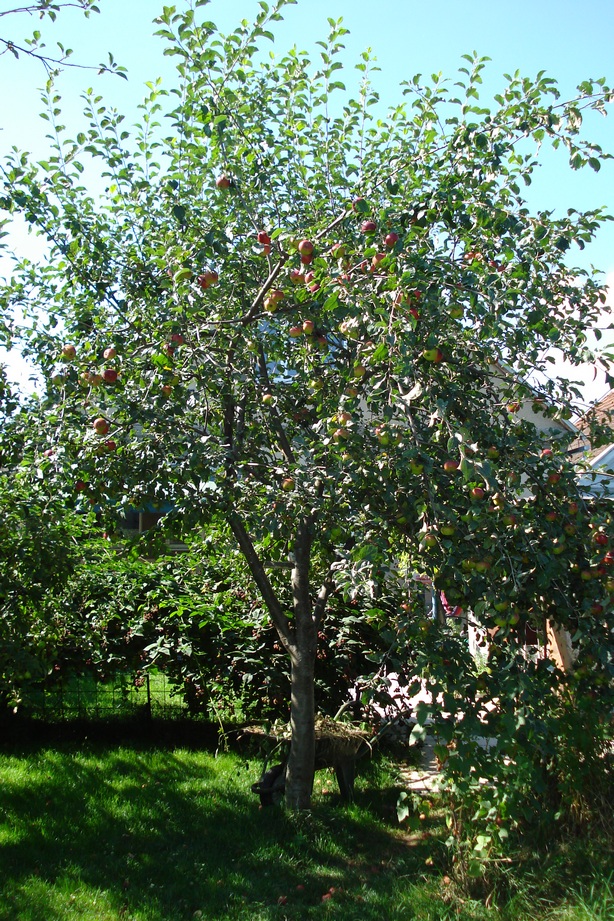
Here are some pictures of the apple tree in our garden, which was our particular focus back in this post.


May
June

August


November
December
January

Outdoor Hour Challenge No. 10 - Picnics

This challenge is about picnics. Maybe it's something about being British, but I've always loved picnics, whatever the weather. I remember when we first moved to our town here in Russia, a local couple took us up into the foothills of the moutains for a picnic, which involved making a fire from scratch and cutting up our own cucumbers and tomatoes there on the grass. It started to rain. "Oh, we're so sorry about this," they said. "Don't worry," we smiled, "We're British. A picnic wouldn't be a picnic without the rain!".

Anyway, for this challenge I wanted to write about two picnics we've recently taken(although perhaps not quite so recently since it's taken me a long time to get round to writing this post!). When dh's parents were here for a visit we took them to our favourite picnic spot up in the foothills (actually, that very same spot where we were taken in the rain 9 years ago). I like to do picnics English-style, i.e. have things already cut up and made beforehand. Dh prefers picnics Russian-style, where you bring everything along and cut it up and make it there and then. For a compromise I cut up the cheese and veggies at home but bring the breadboard and breadknife to make the sandwiches later. One of the things I enjoy about picnics is that the children can run around us while we stay in one spot, instead of, say, going on a walk, where I'm usually dragging one or more of them along by the end because they got 'too tired' at quite a distance from where I parked the car. Russians never picnic too far away from their car (for fear of it being stripped for parts if it's out of sight), which even means them driving over rough terrain to get as close as possible to the picnic site.

Our kids really enjoy picnics up here in the foothills. Perhaps because it's something different. Perhaps because they get to eat loads of crisps (potato chips) without me batting too much of an eyelid. But they particularly enjoy the clambering about on the rocks afterwards looking for interesting clumps of flowers or following the horses that are grazing in the area.


Looking at mountain flowers


     We nearly always find beautiful mountain flowers that I can't identify in my 'Europe' wild flower guide.


The second picnic we took in the extensive town park where we live. The kids enjoyed playing hide and seek behind the trees and running down the little slopes of grass together. On the path on the way back Sophie and Charis discovered hundreds of little striped snails on the gravel path near the man-made lake. We tried to identify which shells no longer had owners and took them home to join our nature collection box on our school-room table. The girls noticed that these snail shells were very different to to the small black snails we tend to find in our garden. This interest led to a quick looking up of some information about snails in the Handbook of Nature Study and on the internet.
Snails from the picnic spot
Small black snails from our front yard

Tuesday, 20 September 2011

Outdoor Hour Challenge No. 9

Outdoor Hour Challenge No. 9 involved marking off a square of ground in our back garden with some string and encouraging the children to look as closely as they could to see what they could see in their square. I had a notebook with me to jot down things they found. I also gave them some small trowels and forks to dig a little deeper under the grass, as well as their magnifying glasses.


“Children should be encouraged to quietly and patiently watch the bee, spider, ant, caterpillar or other wildlife that crosses their path. If this seems dull to them, they just need to watch more closely, because their alert eyes can catch the smallest ways of insects in ways that grown-ups can’t without magnifiers.” Charlotte Mason, volume 1, Outdoor Life, page 57 

 Charis started off by putting down her string square and filling it with things she found in the garden, like an apple, a blackberry.. I had to explain that you had to see what was already there and not add new stuff! After noting down things like grass, brown leaves from the apple tree, moss, dirt......Sophie suddenly found a tiny, dark brown snail, which she had a look at with her magnifying glass. She was surprised that the snail didn't seem at all 'shy' and happily crawled up her hand. We also found some clover and the stem from an apple. Unfortunately there weren't any other bugs or interesting things, although probably if we'd dug deeper (we didn't want to mess up the lawn) we would have found a worm or two.

Here's Sophie's nature study entry, again it's a bit faint, sorry!.

Saturday, 17 September 2011

Outdoor Hour Challenge No. 8

As we start off the new school year (OK, actually we started three weeks ago) I'm planning to continue with the outdoor hour challenges as found on the Handbook of Nature Study blog. So far we're up to challenge number 8, which is all about using magnifying lenses and microscopes.

“In elementary grades, nature study deals with objects which the children can see with the naked eye. However, a lens is a help in almost all of this work because it is such a joy to the child to gaze at the wonders it reveals.” Handbook of Nature Study page 9.

So, armed with their magnifying glasses, Sophie and Charis marched off into our garden with instructions to find something interesting to look at. It took a while to show them the proper distance you should hold between your eye and the glass and the object and the glass to see it at its best. Charis (4) lost interest fairly quickly, but Sophie (6) kept going a bit longer because I'd asked her to sketch a few things in her nature notebook.


 Sorry it's a bit faint, but you might be able to make out a dahlia flower, an empty spider's web amongst the ivy leaves and a spider in the grass.

The girls wanted to take their magnifying glasses along on our next walk around the village, although they didn't actually use them in the end, so I'm hoping that this is something that will grow on them. I'll keep the glasses in our nature study bag so they're always available. We do also have a little bug jar, which has a magnifying lens attached, but it's not very clear, especially by the time the girls have added grass, leaves and water to keep the bug happy!
Related Posts Plugin for WordPress, Blogger...